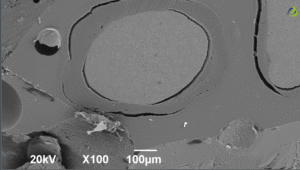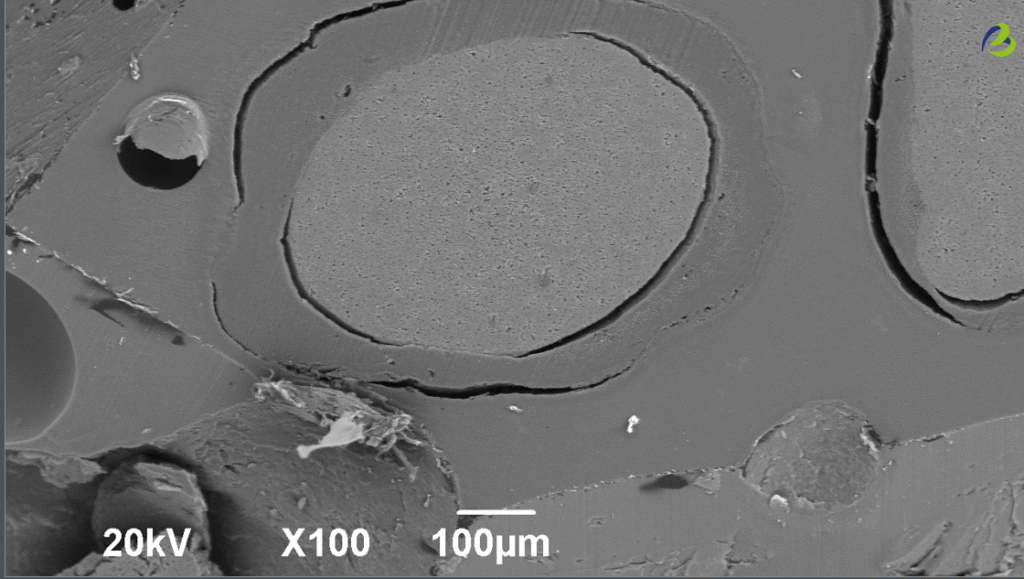
In applied biotechnology for animal nutrition, seeing is a powerful form of validation. Images obtained through Scanning Electron Microscopy (SEM) — particularly through cross-sectional SEM analysis — allow us to observe with high precision both the surface morphology and the internal structure of microorganisms and encapsulating matrices.
This analytical approach is essential for evaluating technologies such as probiotic microencapsulation, because it does not only show the external appearance of particles, but also confirms the internal distribution, structural integrity, and protective efficiency of the encapsulated cells.
At Bialtec, SEM combined with cross-sectional analysis is used to compare encapsulated and non-encapsulated microorganisms, providing visual and structural evidence of the impact of microencapsulation technology.
What Is SEM and Why Is Cross-Sectional Analysis Important?
Scanning Electron Microscopy (SEM) uses a focused beam of electrons instead of light, enabling magnifications and resolutions far beyond conventional optical microscopy. When samples are prepared for cross-sectional SEM analysis, clean transverse cuts expose the internal architecture of the material.
In the context of probiotic microencapsulation, cross-sectional SEM analysis allows us to:
- Visualize the internal polymer structure of the encapsulating matrix
- Confirm the presence and spatial distribution of microorganisms within the matrix
- Assess the homogeneity and structural consistency of the encapsulate
- Differentiate clearly between protected cells and structurally compromised cells
This level of structural evaluation is critical when validating protective technologies intended to maintain microbial viability through industrial processing and gastrointestinal transit.
What Happens to Non-Encapsulated Microorganisms?
SEM imaging and cross-sectional analysis of non-encapsulated yeasts, lactobacilli, and bifidobacteria consistently reveal:
- Cell wall damage and ruptures
- Irregular, collapsed morphologies
- Structural deformation caused by physicochemical stress, including dehydration, temperature fluctuations, and mechanical processing
Without a protective matrix, cross-sectional SEM analysis often shows exposed cells with compromised integrity. These structural alterations directly impact microbial viability and functional performance, limiting the probiotic’s ability to reach its site of action in an active state.
Microencapsulation Observed Through Cross-Sectional SEM Analysis
When Bialtec’s microencapsulated probiotics are examined using cross-sectional SEM analysis, the contrast is evident.
The images demonstrate:
- Structurally intact microbial cells
- Complete embedding of microorganisms within the encapsulating matrix
- Homogeneous distribution throughout the polymer structure
- Absence of exposed or collapsed cells at the surface level
Cross-sectional SEM confirms that microorganisms are not merely adhered to the particle surface — they are fully integrated within the protective matrix, validating the efficiency of the microencapsulation process.
This structural integrity is essential for ensuring that probiotics remain stable during feed manufacturing and are protected against harsh gastrointestinal conditions.
Why Does This Matter for Animal Nutrition?
Microencapsulation is not just a technological concept — it is a functional strategy.
The structural evidence obtained through cross-sectional SEM analysis supports that microencapsulation:
- Preserves microbial viability
- Enables controlled release at targeted regions of the gastrointestinal tract
- Protects cells from environmental and digestive stress
- Correlates with improved outcomes observed in in vitro and in vivo trials
By maintaining structural integrity, microencapsulation enhances the probability that probiotics reach the rumen or intestinal environment in an active state, contributing to improved digestive efficiency, microbiome modulation, and productive performance.
Science That Can Be Observed, Measured, and Validated
Cross-sectional SEM analysis does more than generate high-resolution images — it provides structural validation of functional performance. It bridges the gap between encapsulation engineering and biological efficacy.
At Bialtec, scientific innovation is not only demonstrated through performance data but also through microscopic structural evidence that confirms the effectiveness of our technology at the cellular level.
Because in precision microbiome solutions, protection begins at the microstructure.